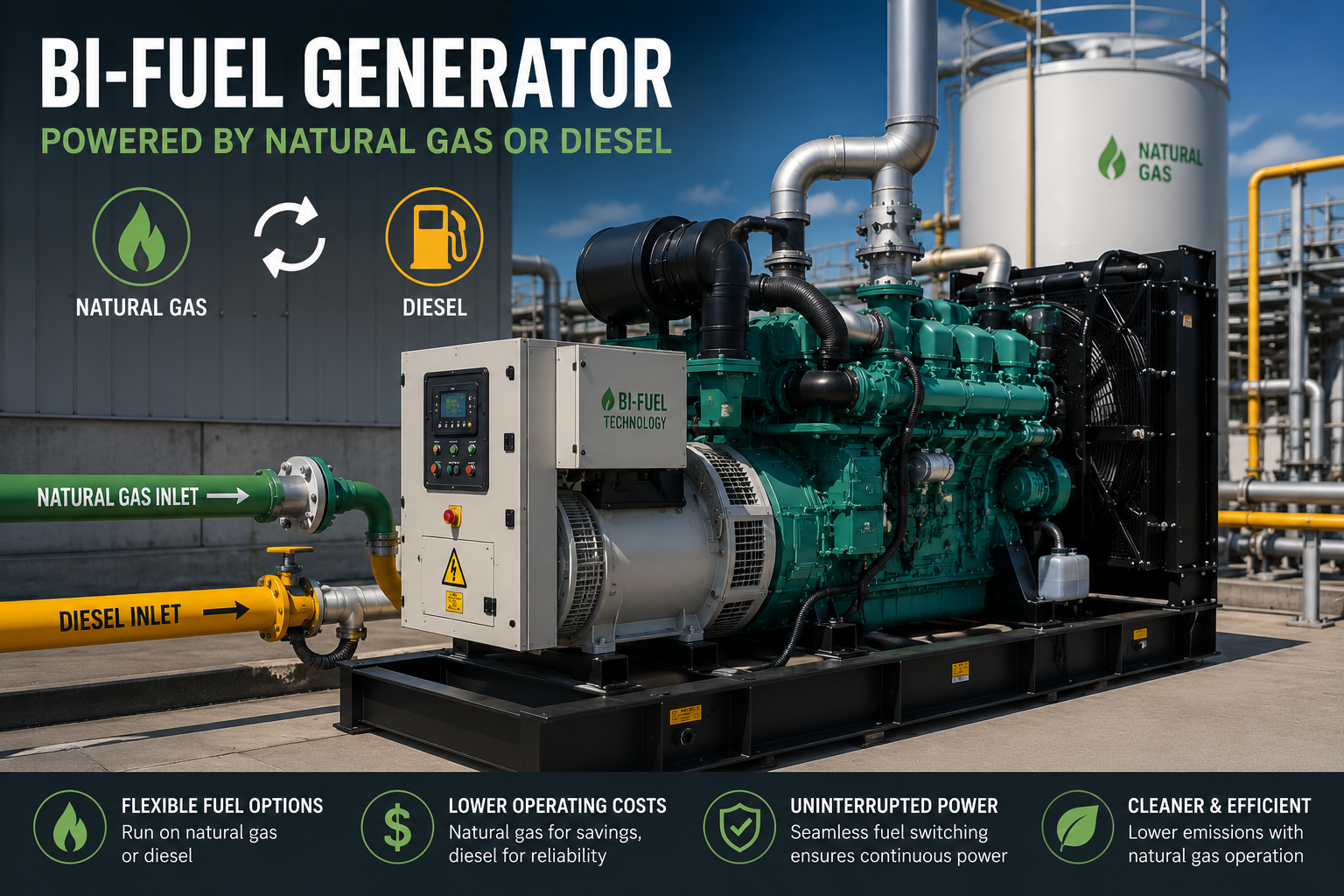
Every extended-outage plan collides with the same problem: diesel tanks run dry. Fuel deliveries during a regional storm are uncertain exactly when you need them most. Bi-fuel technology attacks that problem directly — stretching the same tank two to three times further by substituting pipeline natural gas for most of the diesel burn, without giving up diesel’s instant full-load performance. Here’s how it works and who should consider it.
How Bi-Fuel Generators Work
Diesel engines ignite fuel by compression, and natural gas won’t self-ignite at diesel compression ratios — a property bi-fuel systems exploit. The system meters natural gas into the engine’s intake air; the compressed gas-air mixture is then ignited by a reduced injection of diesel, which acts as a ‘liquid spark plug.’ Electronic controls continuously balance the gas-to-diesel ratio against load, detonation limits, and exhaust temperatures.
- Typical substitution: 50–70% of fuel energy from natural gas at steady mid-to-high loads, less at light load and during transients.
- Automatic fallback: if gas pressure drops or combustion parameters drift, the system reverts seamlessly to 100% diesel at full rating.
- Factory or retrofit: OEMs offer factory bi-fuel models, and certified conversion kits retrofit many common diesel gensets (500 kW+ units are the usual candidates) without voiding engine integrity when properly engineered.
Bi-Fuel vs Dual-Fuel vs Natural Gas: Don’t Confuse Them
| Type | How It Runs | Key Trait |
|---|---|---|
| Bi-fuel | Diesel + NG blended simultaneously | Extends diesel storage; full diesel fallback |
| Dual-fuel (switching) | Either fuel, one at a time | Fuel flexibility; capability varies by fuel |
| Natural gas (spark) | NG only, spark-ignited | No diesel logistics; pipeline-dependent |
| Diesel | Diesel only | Instant full load; finite on-site fuel |
The Case For Bi-Fuel
- 2–3x runtime on the same tank. A 48-hour diesel supply becomes 4–6 days when 60% of the burn shifts to pipeline gas — often the difference between riding out a regional event and scrambling for fuel trucks.
- Lower fuel cost. Natural gas typically delivers energy at roughly half the cost of diesel per kWh, meaningful for prime power, peak shaving, or long test cycles.
- Emissions improvement. Substituting gas reduces particulate matter and NOx versus straight diesel — sometimes easing permitting for extended-run applications.
- Diesel-grade performance retained. Full nameplate output and block-loading capability remain available, because the engine can always run pure diesel.
- Smaller tanks for new sites. Where code runtime requirements drive tank sizing, bi-fuel can shrink required diesel storage — saving pad space and tank cost.
The Case Against
- Upfront cost: retrofit systems and factory bi-fuel options add meaningful cost per unit — payback favors units that actually run hours (prime, extended standby exposure), not sets that idle 20 hours a year.
- Pipeline dependence for the benefit: in earthquakes or events that interrupt gas service, you’re back to diesel-only runtime — the fallback works, but the extension vanishes.
- Engineering matters: poorly tuned kits risk detonation and exhaust-temp issues; use certified integrators and confirm the engine OEM’s position on warranty.
- Regulatory review: emissions certification of retrofits varies by jurisdiction — confirm with your air district, especially for non-emergency duty.
Who Should Consider Bi-Fuel?
| Facility | Fit | Why |
|---|---|---|
| Hospitals / long-duration critical sites | Strong | Runtime assurance beyond stored diesel |
| Data centers | Strong | Extended-run resilience; emissions optics |
| Sites with unreliable fuel delivery (rural/island roads) | Strong | Fewer emergency fuel logistics |
| Peak shaving / demand programs | Moderate | Fuel-cost savings if permitted |
| Pure emergency standby, 20 hrs/yr, urban | Weak | Payback rarely closes |
Frequently Asked Questions
What is the difference between bi-fuel and dual-fuel generators?
Bi-fuel burns diesel and natural gas simultaneously in a blended charge; dual-fuel switches between fuels and runs one at a time. Bi-fuel’s advantage is extending diesel storage while keeping diesel performance; dual-fuel’s is fuel flexibility.
Can any diesel generator be converted to bi-fuel?
Many can — conversions are most common and economic on 500 kW+ engines in good condition with available gas service at adequate pressure. Certified integrators evaluate the specific engine model, duty cycle, and controls before quoting.
Does bi-fuel reduce generator power output?
Properly engineered systems maintain full nameplate output; the controller reduces gas substitution during block loading and transients, leaning on diesel when the engine needs it.
How much diesel does bi-fuel actually save?
At steady loads, 50–70% substitution is typical — so a unit burning 50 gal/hr on diesel might burn 15–25 gal/hr plus pipeline gas in bi-fuel mode, stretching stored fuel 2–3x.
Are bi-fuel generators EPA compliant?
Compliance is an EPA and state/local air district question: factory bi-fuel units carry certifications, while retrofit compliance depends on the kit and jurisdiction — confirm before converting, especially for non-emergency operation.