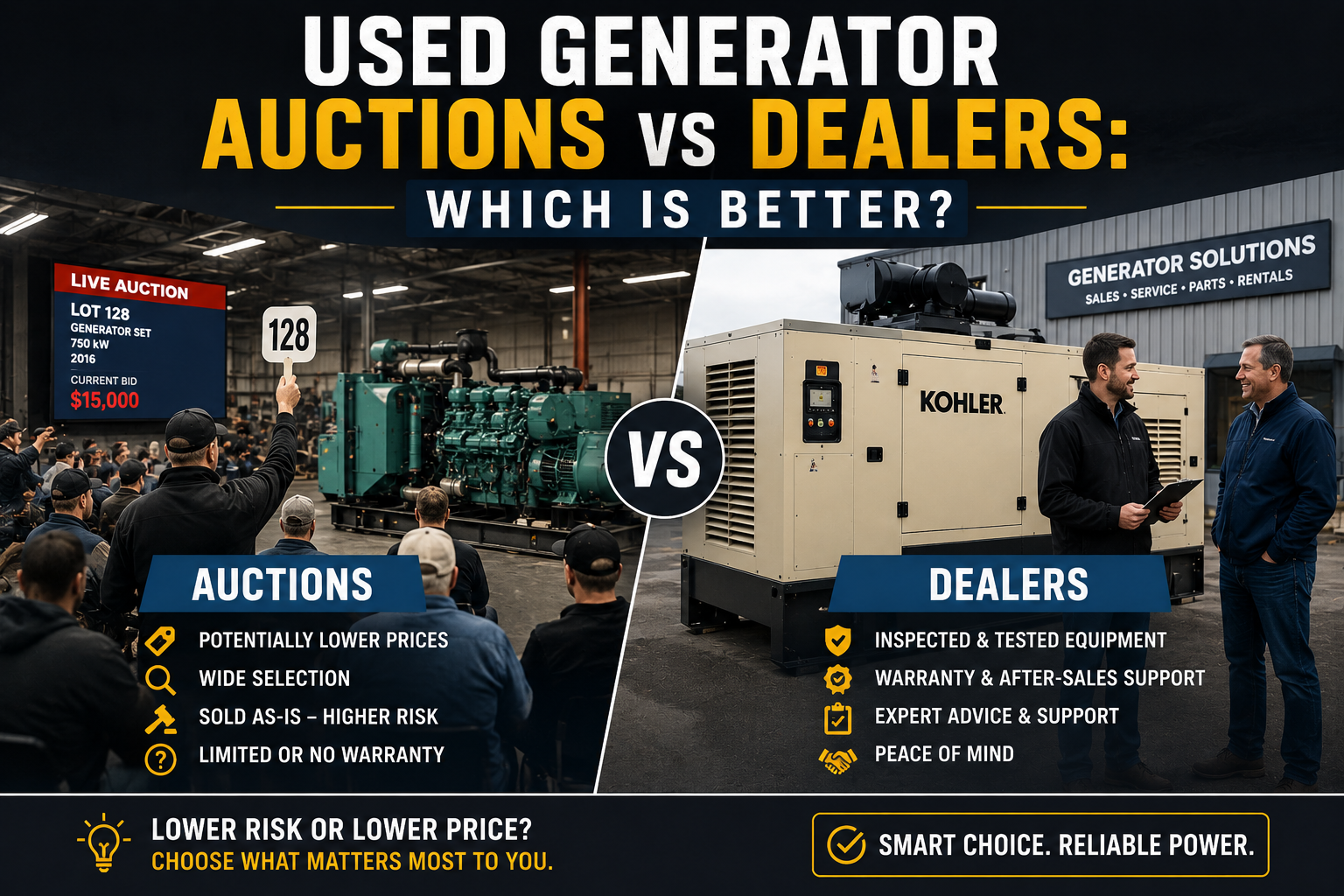
Auction sites are full of generators at eye-catching hammer prices — government surplus, construction fleet sell-offs, bankruptcy liquidations. And dealer listings for similar-looking units can run tens of thousands of dollars higher. Is the dealer premium worth it? Having seen what actually rolls out of auction yards, here’s the honest math.
The Real Cost of an Auction Generator
The hammer price is the beginning, not the end:
| Cost Item | Auction | Dealer |
|---|---|---|
| Purchase price | Hammer price (looks low) | Asking price (looks high) |
| Buyer’s premium | 10–18% added | None |
| Load-bank test & inspection | Rarely offered; you arrange (~$1,000–$3,000) | Included (reputable dealers) |
| Rigging & loading | Buyer’s problem; yard deadlines apply | Coordinated, often quoted upfront |
| Freight | Buyer arranges | Dealer-arranged, insured |
| Repairs found after purchase | 100% on you (as-is) | Disclosed upfront or covered |
| Warranty / recourse | None | Typically 30–90 days or negotiated |
| Documentation (hours, service) | Often missing | Test report, photos, records |
Run the numbers on a nominal $60,000 auction unit: add a 15% premium ($9,000), inspection you couldn’t do ($0 — that’s the problem), rigging on the yard’s schedule ($2,500), freight ($3,500), and one surprise — injectors, a failed AVR, a bad radiator core — and the ‘cheap’ unit lands at or above the dealer price of a tested equivalent, minus the warranty and minus the documentation you’d need at resale.
What Auctions Are Actually Good For
- Experienced buyers with inspection access: if you (or your mechanic) can put eyes, borescope, and fluid samples on the unit before bidding, auctions can genuinely deliver 20–40% savings.
- Non-critical applications: a backup for a barn or a parts unit is a different risk calculation than a hospital’s life-safety system.
- Fleet buyers who average risk: buying ten units, expecting one lemon, works at fleet scale — not for the buyer who needs exactly one good genset.
- Known-provenance sales: municipal/government surplus with maintenance logs, or dispersals of well-run rental fleets, carry less mystery than anonymous consignments.
Where Dealers Earn Their Margin
- Testing you can verify: a load-bank report at 100% nameplate — ideally with a video of the test — is the single strongest predictor of a good outcome. This is the core of what the dealer margin buys.
- Curation: good dealers reject units at the door; the auction yard is where some of those rejected units go.
- Logistics: dealers move gensets weekly and quote delivered pricing with insured carriers and proper rigging.
- Recourse: if a dealer unit arrives with a problem, you have a counterparty with a reputation to protect. At auction, you have a receipt.
- Resale support: dealer documentation (hours, test reports) transfers to your future sale — and many dealers will buy the unit back when you upgrade.
Decision Framework
| Your Situation | Recommended Route |
|---|---|
| Business-critical standby (data, healthcare, food) | Dealer — tested, documented unit |
| Tight budget, non-critical use, can inspect in person | Auction — with pre-bid inspection |
| Need power fast (weeks) | Dealer in-stock inventory |
| Buying multiple units, in-house mechanics | Mixed — auction for parts/spares, dealer for primaries |
| No ability to inspect before bidding | Dealer — never bid blind on a genset |
If You Do Buy at Auction: 7 Rules
- Inspect in person or send a qualified technician — never bid from photos alone.
- Pull oil and coolant samples if the yard permits; lab results cost ~$50 and reveal internal wear.
- Verify hours from the controller’s internal log, and photograph engine/alternator/dataplate serials.
- Price the full landed cost — premium, rigging, freight, inspection, contingency — before setting your max bid.
- Check the EPA tier against your state’s rules; a non-compliant bargain is a liability.
- Know the removal deadline; storage and re-handling fees erode savings fast.
- Budget a 10–20% repair contingency — and walk away if the bidding erases it.
Frequently Asked Questions
Are generator auctions worth it?
For experienced buyers who can inspect before bidding and tolerate as-is risk, yes — savings of 20–40% are achievable. For buyers who need one reliable unit for business-critical power, the all-in cost gap versus a tested dealer unit is usually small and the risk gap is large.
What is a buyer’s premium at equipment auctions?
A fee of typically 10–18% added to the hammer price by the auction house. On a $50,000 bid, expect $5,000–$9,000 on top, plus applicable taxes and documentation fees.
Do auction generators come with any warranty?
Almost never — sales are as-is, where-is. Descriptions are usually not guaranteed, and recourse for misdescribed items is limited and slow.
Where do dealers get their used generators?
Primarily from facility decommissions, data center refreshes, corporate surplus, trade-ins, and selective auction/wholesale purchases — after which reputable dealers inspect, service, and load-bank test units before resale. The dealer’s filter is the value.
Can I sell my used generator at auction instead of to a dealer?
Yes, but net proceeds after seller fees, transport to the yard, and uncertain hammer prices often trail a direct dealer purchase offer — especially for tested, documented units that dealers can confidently resell.