Fuel is the single largest operating cost of a diesel generator — over a long outage or on prime power duty, fuel spend can exceed the price of the generator itself. Whether you’re sizing a fuel tank, budgeting for hurricane season, or comparing a 500 kW unit against two 250 kW units, you need one number: gallons per hour at your actual load.
This guide gives you a complete fuel consumption chart for generators from 20 kW to 2,000 kW at four load levels, the formula behind the numbers, and the real-world factors that push consumption up or down.
Diesel Generator Fuel Consumption Chart (Gallons Per Hour)
Figures are industry-standard estimates for modern diesel gensets. Actual consumption varies by engine make, model year, and EPA tier — always verify against the manufacturer spec sheet. 1 gallon = 3.785 liters.
| Generator Size | 25% Load | 50% Load | 75% Load | 100% Load |
|---|---|---|---|---|
| 20 kW | 0.6 gal/hr | 0.9 gal/hr | 1.3 gal/hr | 1.6 gal/hr |
| 30 kW | 1.3 gal/hr | 1.8 gal/hr | 2.4 gal/hr | 2.9 gal/hr |
| 40 kW | 1.6 gal/hr | 2.3 gal/hr | 3.2 gal/hr | 4 gal/hr |
| 60 kW | 1.8 gal/hr | 2.9 gal/hr | 3.8 gal/hr | 4.8 gal/hr |
| 75 kW | 2.4 gal/hr | 3.4 gal/hr | 4.6 gal/hr | 6.1 gal/hr |
| 100 kW | 2.6 gal/hr | 4.1 gal/hr | 5.8 gal/hr | 7.4 gal/hr |
| 125 kW | 3.1 gal/hr | 5 gal/hr | 7.1 gal/hr | 9.1 gal/hr |
| 150 kW | 3.6 gal/hr | 5.9 gal/hr | 8.4 gal/hr | 10.9 gal/hr |
| 175 kW | 4.1 gal/hr | 6.8 gal/hr | 9.7 gal/hr | 12.7 gal/hr |
| 200 kW | 4.7 gal/hr | 7.7 gal/hr | 11 gal/hr | 14.4 gal/hr |
| 250 kW | 5.7 gal/hr | 9.5 gal/hr | 13.6 gal/hr | 18 gal/hr |
| 300 kW | 6.8 gal/hr | 11.3 gal/hr | 16.3 gal/hr | 21.5 gal/hr |
| 350 kW | 7.9 gal/hr | 13.1 gal/hr | 19 gal/hr | 25.1 gal/hr |
| 400 kW | 8.9 gal/hr | 14.9 gal/hr | 21.6 gal/hr | 28.6 gal/hr |
| 500 kW | 11 gal/hr | 18.5 gal/hr | 26.9 gal/hr | 35.7 gal/hr |
| 600 kW | 13.2 gal/hr | 22 gal/hr | 32.2 gal/hr | 42.8 gal/hr |
| 750 kW | 16.3 gal/hr | 27.4 gal/hr | 40.2 gal/hr | 53.4 gal/hr |
| 1000 kW | 21.6 gal/hr | 36.4 gal/hr | 53.5 gal/hr | 71.1 gal/hr |
| 1250 kW | 26.9 gal/hr | 45.3 gal/hr | 66.8 gal/hr | 88.8 gal/hr |
| 1500 kW | 32.2 gal/hr | 54.3 gal/hr | 80.1 gal/hr | 106.5 gal/hr |
| 1750 kW | 37.5 gal/hr | 63.2 gal/hr | 93.5 gal/hr | 124.2 gal/hr |
| 2000 kW | 42.8 gal/hr | 72.2 gal/hr | 106.8 gal/hr | 141.9 gal/hr |
How to Calculate Diesel Generator Fuel Consumption
If your generator size isn’t in the chart, two quick methods get you close:
Method 1: The 0.07 Rule
Fuel (gal/hr) ≈ kW of actual load × 0.07
Example: a 350 kW generator running at 60% load carries 210 kW. 210 × 0.07 ≈ 14.7 gal/hr. This rule works because modern diesel gensets produce roughly 13–15 kWh per gallon of diesel.
Method 2: From the Spec Sheet (Most Accurate)
Every manufacturer spec sheet lists fuel consumption at 25/50/75/100% of the standby or prime rating. Interpolate between the two nearest load points. Spec-sheet figures already account for that engine’s brake-specific fuel consumption (BSFC), so they beat any generic chart.
7 Factors That Change Real-World Fuel Consumption
- Load factor: running at 30% load doesn’t use 30% of full-load fuel — light-loaded diesels are less efficient per kWh, and sustained operation under ~30% load also causes wet stacking.
- Standby vs prime rating: the same engine consumes differently against its standby rating (higher output) than its prime rating.
- EPA tier and engine technology: common-rail Tier 3/Tier 4 engines typically burn 5–10% less fuel than older mechanical-injection Tier 1 units of the same size.
- Altitude and temperature: thin air derates the engine; expect ~3% output loss per 1,000 ft above rated altitude, which shifts your load factor upward.
- Power factor: charts assume 0.8 PF. A facility running at lower power factor draws more kVA — and more fuel — for the same real power.
- Fuel quality and blends: biodiesel blends (B20) carry ~2% less energy per gallon; winter blends slightly less again.
- Maintenance condition: clogged air filters, worn injectors, and incorrect valve lash all measurably increase consumption.
How Long Will a Fuel Tank Last?
Runtime (hours) = usable tank gallons ÷ gal/hr at your load.
| Scenario | Load | Consumption | 500-gal Tank | 1,000-gal Tank |
|---|---|---|---|---|
| 150 kW genset, office building | 75% (113 kW) | 8.4 gal/hr | ~59 hrs (2.5 days) | ~119 hrs (5 days) |
| 500 kW genset, small data hall | 75% (375 kW) | 26.9 gal/hr | ~18 hrs | ~37 hrs |
| 1,000 kW genset, hospital | 50% (500 kW) | 36.4 gal/hr | ~14 hrs | ~27 hrs |
NFPA 110 requires Level 1 systems (hospitals, life safety) to store enough fuel for their assigned class runtime — commonly 48 or 96 hours — with tanks sized at 133% of calculated demand to account for unusable volume and expansion. Size tanks from the 100% load column even if you expect to run lighter.
Diesel vs Natural Gas: Fuel Cost Per kWh
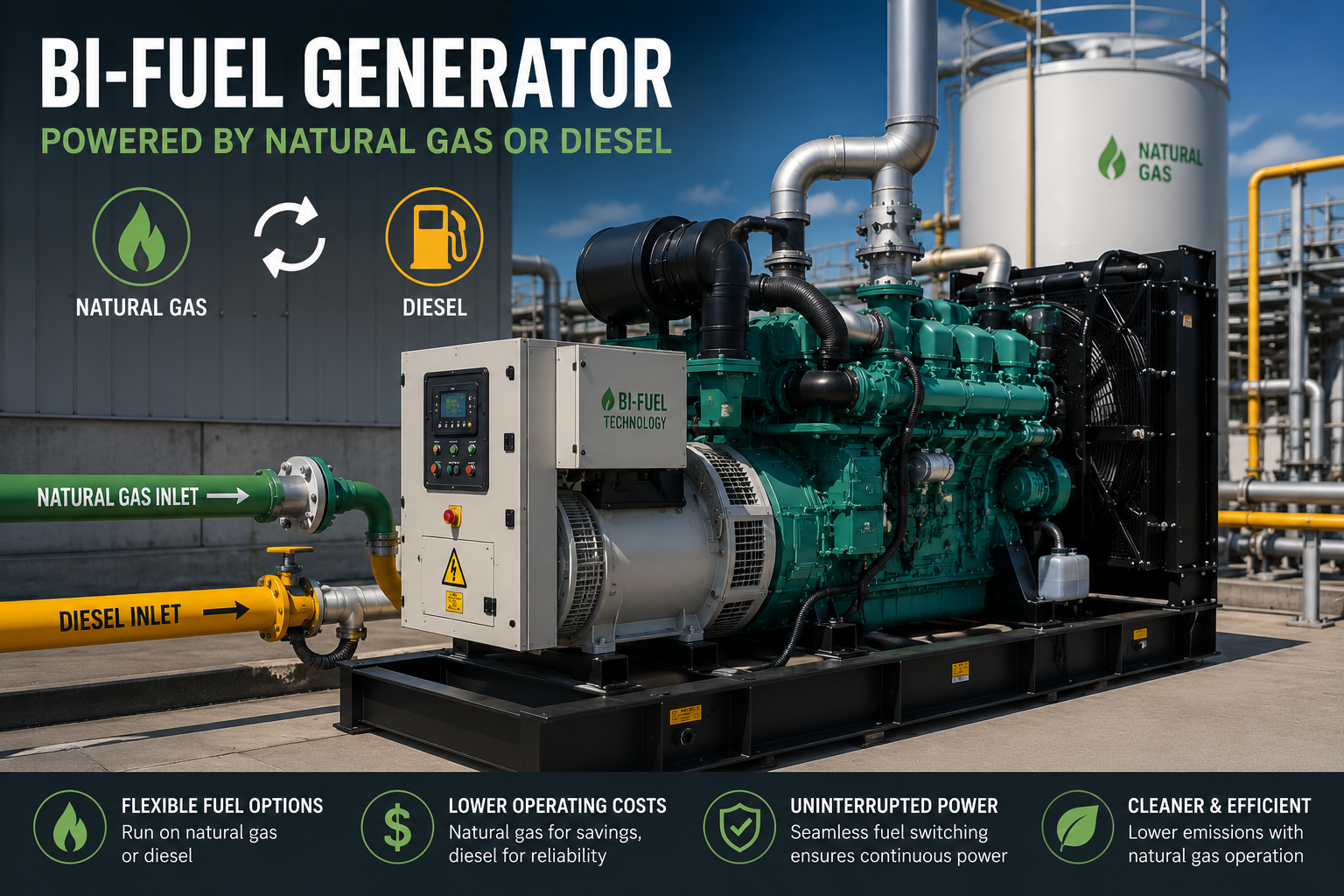
At $3.50/gallon diesel and ~14 kWh per gallon, diesel power costs roughly $0.25 per kWh. Natural gas at $8/MMBtu delivers roughly $0.09–$0.12 per kWh in a comparable genset — but diesel stores on-site, delivers full rated power instantly, and isn’t dependent on pipeline pressure during a regional emergency. That’s why diesel still dominates code-required standby applications.
Frequently Asked Questions
How much fuel does a 500 kW diesel generator use per hour?
About 35.7 gallons per hour at full load, 26.9 gal/hr at 75% load, and 18.5 gal/hr at 50% load. Over a 24-hour outage at 75% load, that’s roughly 645 gallons.
How much diesel does a generator use per day?
Multiply the chart’s gal/hr figure by 24. A 100 kW unit at 50% load uses about 98 gallons/day; a 1,000 kW unit at 50% load uses about 874 gallons/day.
Is it cheaper to run a generator at higher load?
Per kWh produced, yes. Diesel engines hit peak efficiency around 70–80% load. Running two paralleled units at 40% each costs more per kWh than one unit at 80% — one reason paralleled systems stage gensets on and off automatically.
What is wet stacking and does light loading cause it?
Wet stacking is unburned fuel and soot accumulating in the exhaust when a diesel runs below ~30% load for extended periods. It reduces efficiency and can damage the engine. If your standing load is light, schedule periodic load-bank exercise at 50%+ load.
How accurate are generic fuel consumption charts?
Within about ±10% for modern units. Charts are ideal for budgeting and tank sizing; use the manufacturer’s spec sheet for contractual or compliance calculations.