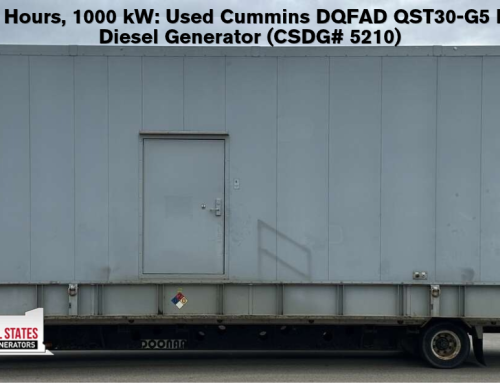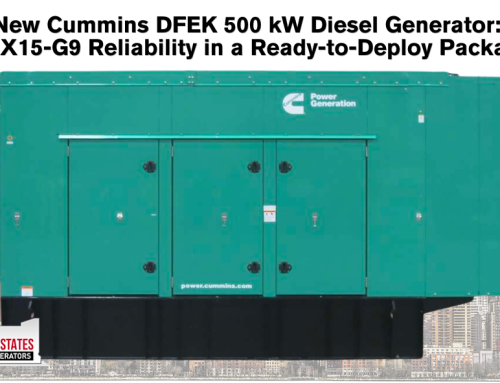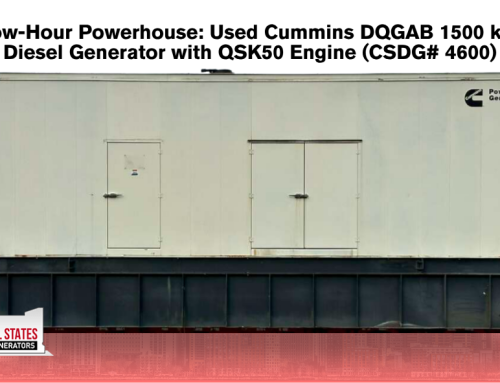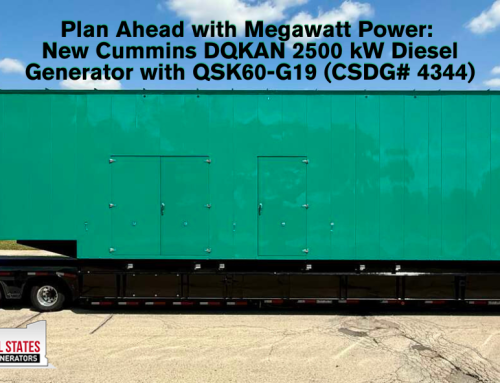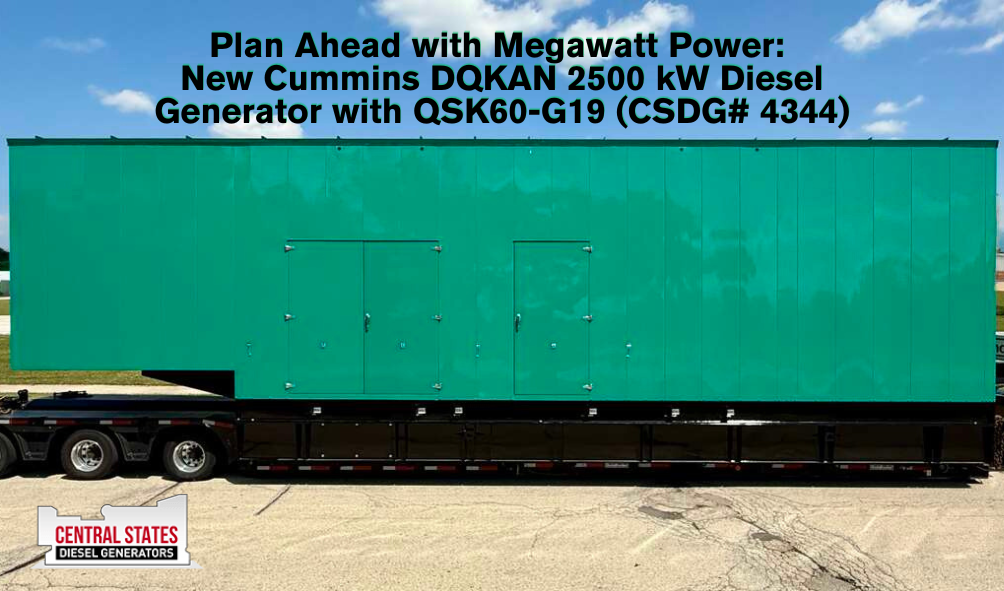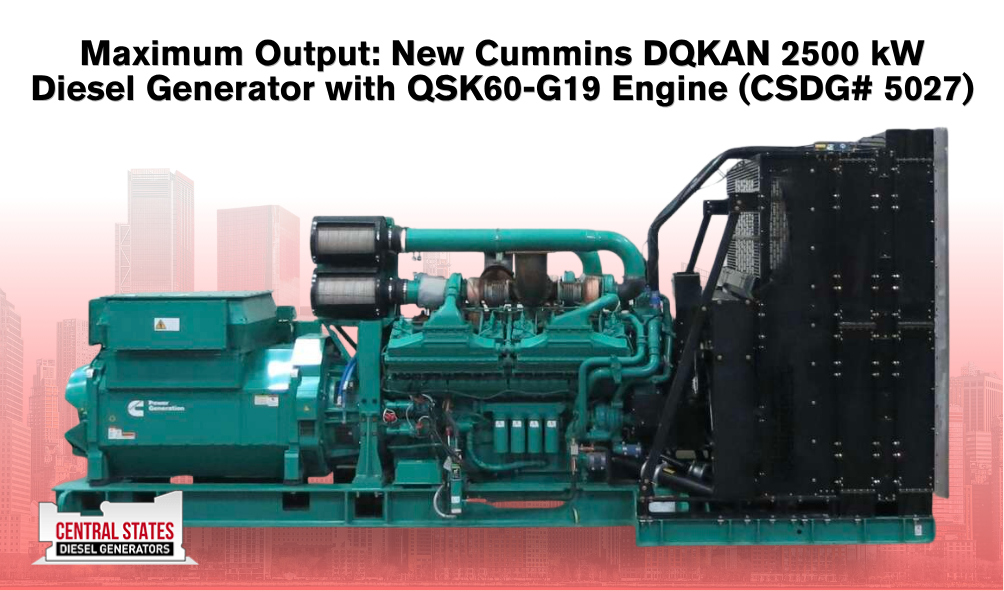
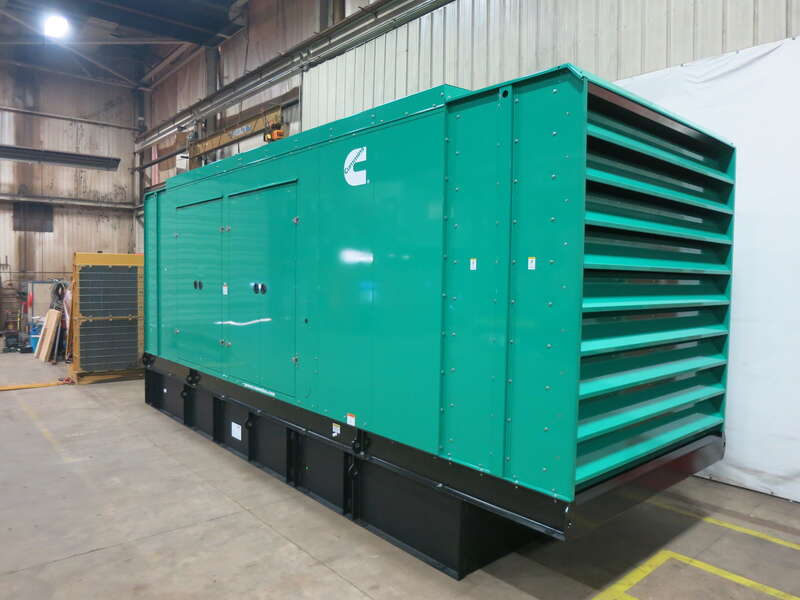
The 750 kW class sits in a sweet spot: big enough to carry an entire mid-size facility, small enough to ship as a single standard skid without the switchgear complexity of multi-megawatt paralleled plants. It’s also one of the most active segments of the used market, fed by data center refresh cycles and hospital upgrades. Here are the ten models worth shortlisting in 2026, and how to choose between them.
750 kW Generator Quick Comparison
| Model | Engine | Cylinders | Notes |
|---|---|---|---|
| Cummins DQCB | Cummins QSK23 | 6 in-line | Compact footprint; common data center take-out |
| Caterpillar C27 | CAT C27 ACERT | V12 | Modern platform; strong parts network |
| Caterpillar 3412C | CAT 3412C | V12 | Legendary durability; abundant used supply |
| Kohler 750REOZMD | MTU 12V2000 | V12 | Kohler package, MTU power; hospital favorite |
| Kohler KD750 | Kohler KD series | V12 | Newer KD platform; Tier-flexible builds |
| MTU DS750 | MTU 12V2000 | V12 | Excellent load response; data center standard |
| Generac SD750 | Generac/partner diesel | V12 | Value pricing; integrated controls |
| Cummins DFHC-class (VTA28) | Cummins VTA28-G5 | V12 | Older but proven; budget used option |
| HiPower HRVW-750 | Volvo Penta | V12/16L | Open or enclosed; competitive pricing |
| Taylor TD750 | Various (MTU/Volvo) | V12 | US-built packager; custom enclosures |
1. Cummins DQCB — Best Overall 750 kW
The DQCB pairs Cummins’ QSK23 — a 23-liter inline-six — with the PowerCommand control ecosystem (PCC3300 family). The inline-six layout means fewer cylinders to maintain than V12 rivals, and the QSK23’s common-rail injection delivers strong fuel economy for the class. DQCBs are heavily used in data centers, which means well-documented, low-hour used units regularly reach the market. Parts availability through the Cummins distributor network is excellent.
- Best for: buyers who want the strongest used availability and simplest maintenance in the class
2. Caterpillar C27 — Best Modern CAT Platform
The C27 ACERT V12 covers roughly 680–800 kW standby and replaced the 3412 in CAT’s lineup. It offers better fuel economy and emissions flexibility than its predecessor while keeping CAT’s unmatched dealer network. EMCP controls integrate cleanly with paralleling switchgear. New-build lead times are long; clean used C27 units command premium prices but hold value exceptionally well.
3. Caterpillar 3412C — Best Proven Workhorse
The 3412 family powered everything from fire pumps to offshore rigs for three decades, and at 750 kW standby the 3412C remains one of the most trusted engines ever packaged into a genset. Mechanical simplicity makes it a favorite where sophisticated aftertreatment isn’t required, and the used market is deep, with rebuild parts everywhere. For emergency standby in permissive jurisdictions, a load-tested 3412C is often the best value in the entire 750 kW class.
4. Kohler 750REOZMD — Best for Hospitals
Kohler’s 750REOZMD packages the MTU 12V2000 engine with Kohler’s Decision-Maker controls and UL2200 listing. Kohler’s strength in code-driven healthcare work shows in the documentation, transfer-switch integration, and NFPA 110 compliance support. These units frequently appear used from hospital replacements with meticulous service records.
5. Kohler KD750 — Best New-Generation Option
The KD series is Kohler’s (now Rehlko’s) own large-engine platform, developed with Liebherr. The KD750’s engine is designed specifically for generator duty, with strong steady-state stability and Tier 4-capable configurations. As a newer platform, used supply is thinner, but new-build availability is sometimes better than rivals because the engine isn’t shared with truck or construction markets.
6. MTU DS750 — Best Load Response
MTU’s 12V2000-based DS750 is a data center staple, prized for fast load acceptance and generous overload margin. Rolls-Royce Power Systems engineering shows in the build quality. Used DS750s from hyperscale refresh programs are among the best used buys anywhere — typically low hours, indoor-installed, and professionally maintained from day one.
7. Generac SD750 — Best Value New
Generac’s industrial SD750 undercuts the premium brands on price while offering integrated Generac controls and packaging. The trade-off is a thinner heavy-industrial service network than CAT or Cummins. For cost-driven standby projects — warehouses, mid-rise commercial — the SD750 delivers the class’s lowest cost per kW new.
8. Cummins VTA28-Powered Units — Best Budget Used
Before the QSK-era, Cummins’ VTA28 V12 powered a generation of 600–750 kW gensets. These mechanical-injection units are simple, rebuildable, and cheap on the used market. They suit budget-conscious buyers in permissive emissions jurisdictions who want proven iron over electronics.
9. HiPower HRVW-750 — Best Volvo-Powered Alternative
HiPower packages Volvo Penta engines into competitively priced 750 kW units, open-skid or enclosed. Volvo Penta’s industrial engines are efficient and parts-supported through a solid North American network. A good lever for buyers quoting multiple brands to control project cost.
10. Taylor TD750 — Best Custom Packaging
Taylor Power Systems, a US packager, builds the TD750 on proven engine platforms with highly customizable enclosures, tanks, and controls. Useful when site constraints — sound limits, tight footprints, special fuel capacity — demand a built-to-spec package rather than a catalog unit.
750 kW Generator Key Numbers
| Spec | Typical Value |
|---|---|
| kVA rating (0.8 PF) | 938 kVA |
| Full-load fuel consumption | ~53 gal/hr |
| Fuel for 24-hr outage at 75% load | ~965 gallons |
| Typical voltage | 277/480V 3-phase (12470V options via transformer) |
| Weight (enclosed w/ tank) | 25,000–40,000 lbs |
| New price range (2026) | $350,000–$600,000+ depending on tier/enclosure |
| Used price range (2026) | $150,000–$350,000 for tested low-hour units |
How to Choose
- Check real load, not nameplate: if your calculated demand is 450 kW, a 500–600 kW unit at healthier load factor may beat an underloaded 750.
- Match the tier to the application: emergency-only standby can often use Tier 2/3 used units; any non-emergency duty needs Tier 4 Final.
- Demand the load-bank report: a 750 kW unit should be tested at 100% nameplate — insist on the report and a video under load.
- Plan the logistics: these units need a crane and heavy-haul freight; get delivery and rigging quoted with the machine.
Frequently Asked Questions
What can a 750 kW generator power?
Roughly a 150,000–250,000 sq ft commercial building, a 100–200 bed hospital’s essential systems, a mid-size manufacturing line, or about 500–600 homes’ worth of load. At 0.8 power factor it supplies 938 kVA.
How much does a 750 kW diesel generator cost?
New: roughly $350,000–$600,000+ depending on emissions tier, enclosure, and tank. Used, load-tested units typically run $150,000–$350,000 — with low-hour data center take-outs at the upper end.
How much fuel does a 750 kW generator use?
About 53 gal/hr at full load, 40 gal/hr at 75%, and 27 gal/hr at 50% load. A 2,000-gallon tank provides roughly 48 hours at 75% load.
Which 750 kW generator brand is most reliable?
Cummins (QSK23) and Caterpillar (C27/3412) lead on track record and parts networks, with MTU’s 2000-series a close peer favored in data centers. Reliability in practice depends more on maintenance history than brand — which is why documentation matters most on used units.