This page compiles the most useful, current statistics on the backup power industry — market size, outage trends, downtime costs, data center demand, lead times, and the used equipment market — with sources, updated for 2026. Bookmark it for budget justifications, board decks, and resilience planning.
Diesel Generator Market Size Statistics
- The global diesel generator market is estimated at $19.3–25.3 billion in 2025, depending on scope of the estimate (Fortune Business Insights; Mordor Intelligence).
- Forecasts put the market at $34–41 billion by the early 2030s, implying a 6–10% CAGR (Mordor Intelligence; Fortune Business Insights; SNS Insider).
- North America remains one of the largest regional markets, driven by data centers, healthcare, and grid-reliability concerns.
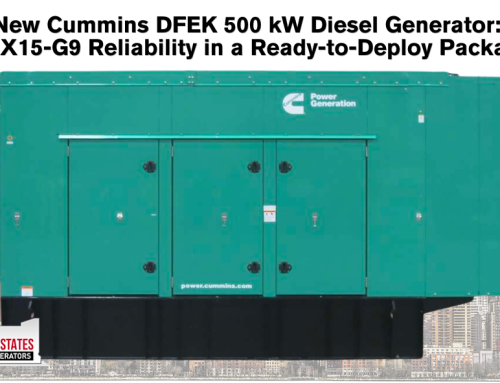
- Diesel still dominates code-required standby power because it stores on-site and delivers full rated load within 10 seconds — a requirement of NFPA 110 Level 1 systems.
US Power Outage Statistics
- US electricity customers averaged roughly 11 hours of power interruptions in 2024 — among the worst years in the past decade (EIA).
- The average duration of a customer’s longest outage rose from 8.1 hours in 2022 to 12.8 hours by mid-2025 (J.D. Power / Utility Dive).
- The southern US experiences the longest average outages — 18.2 hours (regional utility reliability data).
- Extreme weather is the leading cause of major outages, and weather-driven events have roughly doubled in frequency since the early 2000s.
- Power outages cost the US economy an estimated $150 billion per year (DOE-cited estimates), with major-event costs reaching $121 billion in 2024 alone.
Cost of Downtime Statistics
| Metric | Figure |
|---|---|
| Average outage cost, commercial & industrial customer (2024) | $6,031 per event |
| Server/IT downtime, mid-size to large enterprise | $300,000+ per hour for ~90% of firms |
| Data center downtime (Uptime Institute surveys) | Over half of significant outages cost >$100,000; ~1 in 6 exceeds $1 million |
| Healthcare, manufacturing, cold storage | Losses compound with spoilage, restart time, and compliance exposure |
Against these figures, a $150,000–$400,000 used genset with installation typically pays for itself in one avoided major outage for a mid-size facility.
Data Center & AI Demand Statistics
- The data center generator market alone is estimated at $7.6–10.3 billion in 2025–2026, forecast to roughly double by 2034 (Precedence Research; Fortune Business Insights).
- US data center diesel generator capacity grew from ~20 GW nameplate in 2018 to ~55 GW by 2024 (SecondWatt analysis).
- Virginia alone had permitted 10,500+ generator units totaling ~27 GW nameplate by end-2025 — more standby capacity than many national grids.
- AI racks now draw up to 100 kW each, forcing operators to redesign backup architectures around larger, paralleled gensets (Mordor Intelligence).
- Major engine manufacturers report record backlogs — Caterpillar’s total backlog reached ~$63 billion, and large-genset production slots at major OEMs are reported allocated into 2028 (Terrapin Consulting Group).
Generator Lead Time Statistics (2026)
| Equipment | Typical Lead Time (2026) | Pre-2020 Norm |
|---|---|---|
| 25–400 kW standby diesel (new) | 12–26 weeks | 4–8 weeks |
| 500–1,000 kW standby diesel (new) | 26–52 weeks | 10–16 weeks |
| 1,250–3,250 kW standby diesel (new) | 52+ weeks | 16–24 weeks |
| Medium-voltage switchgear | up to 72 weeks | ~24 weeks |
| In-stock used/surplus genset | 1–4 weeks (ship time) | 1–4 weeks |
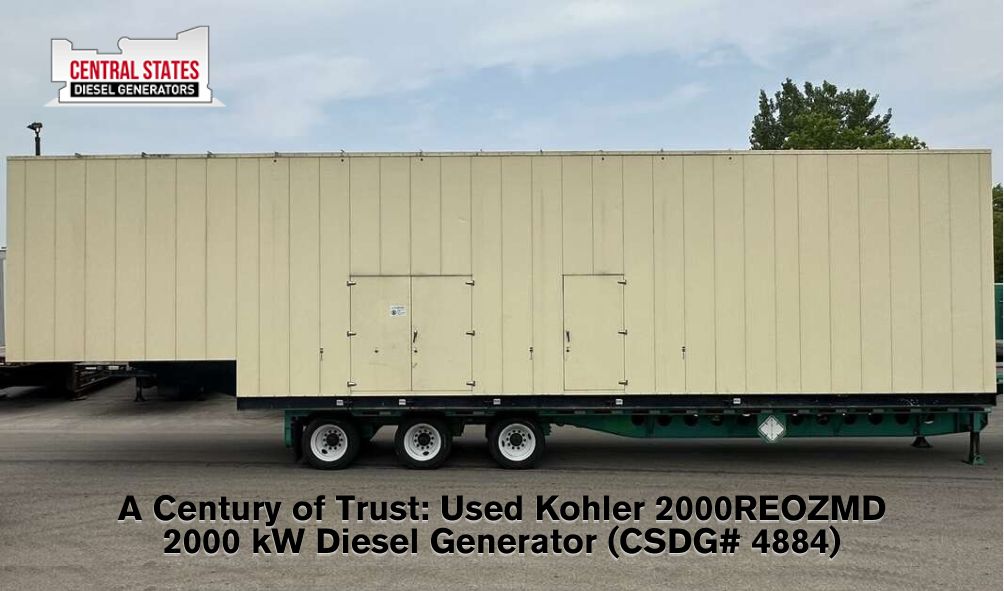
The last row explains the structural shift in the market: with new large gensets quoted a year or more out, tested used and surplus units — deliverable in weeks — have become the primary option for projects that can’t wait (Global Power Supply; Terrapin Consulting Group).
Used Generator Market Statistics
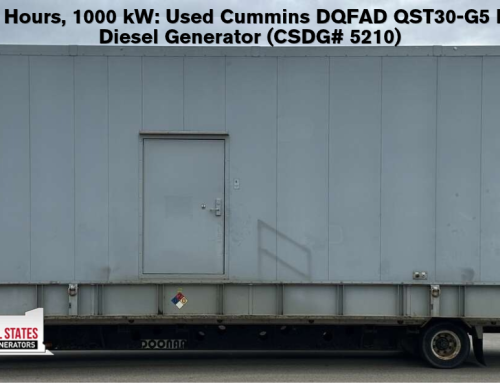
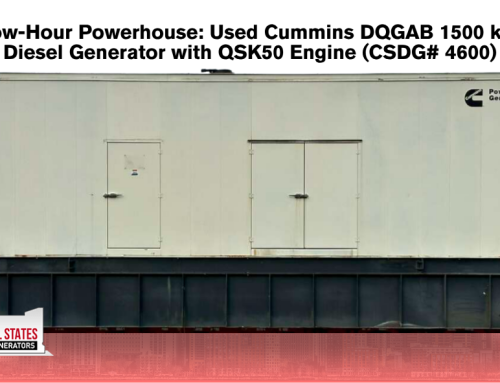
- Used industrial generators typically sell for 30–70% below comparable new units, with low-hour standby take-outs at the top of that range.
- Well-maintained industrial diesel gensets have service lives of 20,000–30,000+ hours — decades of standby duty — so low-hour used units carry most of their useful life.
- Caterpillar and Cummins units hold resale value best, supported by the largest parts and service networks.
- Extended new-unit lead times have lifted used prices and shortened used inventory cycles across major dealers since 2023.
Fuel & Operating Statistics
- A diesel generator burns roughly 0.07 gal/hr per kW of load — about 7.4 gal/hr for a loaded 100 kW unit and 71 gal/hr at 1,000 kW.
- Diesel engines reach peak efficiency at 70–80% load; sustained operation under ~30% load risks wet stacking.
- NFPA 110 requires monthly exercise under load and annual load-bank testing for Level 1 emergency systems.
- Properly stored diesel fuel lasts 6–12 months untreated; with stabilizers and fuel polishing, storage life extends to several years.
What These Numbers Mean for Buyers
Three takeaways. First, grid reliability is trending worse, not better — the case for standby power strengthens every year. Second, the AI buildout has absorbed new-unit manufacturing capacity through at least 2027, so buyers with near-term needs should price tested used or in-stock units first. Third, downtime costs dwarf equipment costs for most commercial operations, which is why generator spending keeps growing at high single digits even in soft construction markets.
Frequently Asked Questions
How big is the diesel generator market in 2026?
Estimates range from about $19 billion to $25 billion globally depending on scope, with forecasts of $34–41 billion by the early 2030s.
Are power outages really getting worse in the US?
Yes. Average annual interruption time reached ~11 hours per customer in 2024, and the average longest-outage duration rose ~58% between 2022 and mid-2025, driven primarily by extreme weather.
Why are generator lead times so long?
Data center construction is consuming large-engine manufacturing capacity; backlogs at major OEMs stretch into 2027–2028 for big gensets. Switchgear and transformer shortages compound project timelines.
How much does one hour of downtime cost a business?
It varies enormously: about $6,000 per outage for the average commercial/industrial customer, but $300,000+ per hour for most mid-size and large enterprises dependent on IT systems, and $1 million+ for a meaningful share of data center incidents.